
This paper develops a semiclassical framework for one-dimensional Heisenberg magnets with spin S>1/2, where classical approaches are reliable only as S→∞ and can miss quantum contributions from multipole moments. The aim is to construct a workable mathematical apparatus that connects the quantum lattice Hamiltonian to an effective classical field description while incorporating an effective reduction of the classical spin length. The analysis starts from an anisotropic Heisenberg chain with nearest-neighbour exchange and single-ion anisotropy. After outlining the continuum (long-wavelength) reduction, including factorization of slowly varying fields and replacement of commutators by Poisson brackets, the semiclassical limit is formulated using a Hartree product ansatz and generalized SU(N) coherent states for each lattice site. For spin S=1 the coherent state is built on the SU(3)/[SU(2)×U(1)] manifold. Two Euler angles define the orientation of the classical spin vector, an additional angle describes rotation of the quadrupole tensor about this vector, and a real parameter g controls the redistribution between dipolar and quadrupolar sectors. Averaging the spin operators yields explicit classical components and shows that the standard constraint |S|^2=1 is violated. Instead, an identity relates the reduced spin length to a combination of double correlators, demonstrating that quadrupolar degrees of freedom quantitatively produce a measurable renormalization of the effective classical spin. For spin S=3/2 the construction is generalized to SU(4) coherent states, where both quadrupole and octupole moments arise naturally. The averaged spin operators again violate spin-length conservation and, moreover, simple projection sum rules. The corresponding SU(4) identities involve combinations of triple correlators and introduce parameters g and k that quantify reductions due to quadrupolar and octupolar sectors, respectively; the SU(3) case is recovered when k=0. The framework provides a transparent route to include multipolar physics in semiclassical dynamics and is relevant for interpreting nonlinear collective excitations, including soliton-like modes, in quantum spin chains.
| Published in | World Journal of Applied Physics (Volume 11, Issue 1) |
| DOI | 10.11648/j.wjap.20261101.12 |
| Page(s) | 7-15 |
| Creative Commons |
This is an Open Access article, distributed under the terms of the Creative Commons Attribution 4.0 International License (http://creativecommons.org/licenses/by/4.0/), which permits unrestricted use, distribution and reproduction in any medium or format, provided the original work is properly cited. |
| Copyright |
Copyright © The Author(s), 2026. Published by Science Publishing Group |
One-dimensional Heisenberg Magnet, Quantum Spin Chain, Semiclassical Approximation, Coherent States, SU(3) and SU(4) Symmetry, Multipole Moments (Quadrupole, Octupole), Effective Classical Spin Reduction, Classical Field Model
Substance | Spin | Dimension | Quantity of exchange integral |
|---|---|---|---|
H3Fe(CB6) | ½ | 1 | -0,23 |
(NH4)MnF5 | ½ | 1 | -12 |
CsCoCl3·2H2O | ½ | 1 | -23 |
CsCoCl3 | ½ | 1 | -75 |
CoCl2·2NC5H5 | ½ | 1 | +9,5 |
CoCl2·2H2O | ½ | 1 | +9,3 |
[(CH3)3NH]CoCl3·2H2O | ½ | 1 | +9,9 |
RbFCl3·2H2O | ½ | 1 | -0,35 |
CoCs3Rr5 | ½ | 2 | -0,22 |
Co(HCOO)2·2H2O | ½ | 2 | -4,3 |
RB2CoF4 | ½ | 2 | -91 |
K2CoF4 | ½ | 2 | -97 |
FeCl2 | ½ | 2 | +3,4 |
CsFeCl3·2H2O | ½ | 1 | -42 |
Substance | Spin | Dimension | Quantity of J/K |
|---|---|---|---|
CuSO4·5H2O | ½ | 1 | -1,45 |
CuSeO4·5H2O | ½ | 1 | -0,8 |
Cu(NH3)4SO4·H2O | ½ | 1 | -3,5 |
Cu(NH3)4SO4·H2O | ½ | 1 | -2,36 |
CuCl2 | ½ | 1 | |
CuBr2 | ½ | 1 | |
Cu(HCO2)2·(OH)2 | ½ | 2 | |
Cu(C6H5COO2)·3H2O | ½ | 1 | |
Cu(NH3)(NO3)2 | ½ | 1 | 1,2 |
CuCl2·2NC5H5 | ½ | 1 | -13 |
KcuF3 | ½ | 1 | -190 |
CsNiCl3 | ½ | 1 | -13 |
RbNiCl3 | 1 | 1 | -17 |
(CH3)4NNCl3 | 1 | 1 | +2 |
CsNiF3 | 1 | 1 | +11,8 |
KniF3 | 1 | 1 | |
TlNiCl3 | 1 | 1 | +2 |
K2NiF4 | 1 | 1 | |
Rb2NiF4 | 1 | 1 | |
Tl2NiF4 | 1 | 1 | |
Ba2NiF6 | 1 | 1 | |
NH4NiCl3 | 1 | 1 | |
Ni(HCOO)2·2H2O | 1 | 1 | |
CsMnCl3·2H2O | 5/2 | 1 | -6,5 |
CsMnF3 | 5/2 | 1 | |
CsMnI3 | 5/2 | 1 | |
RbMnBr3 | 5/2 | 1 | |
C3MnBr3 | 5/2 | 1 | |
BaMnF4 | 5/2 | 2 | |
K2MnF4 | 5/2 | 2 | 10,1 |
Rb2MnF4 | 5/2 | 2 | 0,3 |
Rb2MnCl4 | 5/2 | 2 | 9,2 |
Cs2MnCl4 | 5/2 | 2 | 3,0 |
CsMnCl3·2H2O | 5/2 | 1 | 3,2 |
CsMnBr3·2H2O | 5/2 | 1 | 3,0 |
TMMC | 5/2 | 1 | -6,5 |
VoCE | 2 | 1,48 | |
RbFeCl3 | 2 | 1 | ? |
FePs3 | 3/2 | 1 | ? |
CsCuCl3 | ½ | 1 | ? |
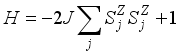
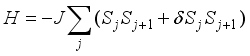
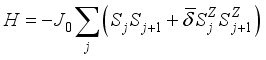 (2)
(2)  - the constant of anisotropia.
  (3)
(3) 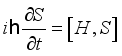 (4)
(4) 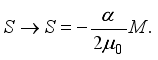 (5)
(5) 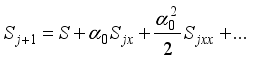 (6)
(6) 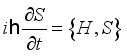 (7)
(7) 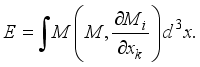 (8)
(8)  (9)
(9)  - are the complex functions, and
  - are the referent states. In view of arbitrariness of selection of phase
  and the conditions of rate setting:
 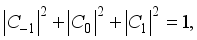 (10)
(10)  (11)
(11)  - is the unitary operator, similar to Winger operator, which ensures transiting self-traveling system of coordinates for each lattice site. Two Euler angle <i></i> and <i></i> determine orientation of the vector of classical spin, and the angle <i></i> characterizes rotation of quadrupole moment around the vector of spin. As it was mentioned in
  like:
like: 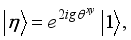 (12)
(12) 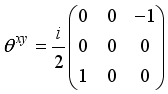 is the quadrupole moment.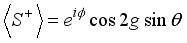
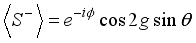 (13)
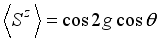
(13) 
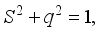 (14)
(14)  (15)
(15) 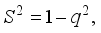 (16)
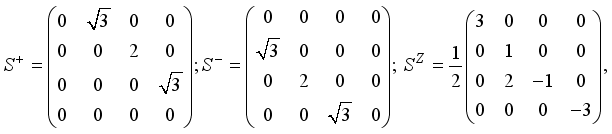
(16) 


 (17)
(17) 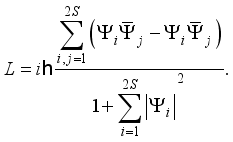 (18)
(18)  (19)
(19) 
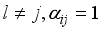


 (20)
(20)  - is the combination of triple correlators, which has the following form:

 (21)
(21) 
 - is the combination of triple correlators, which has the following form:
 (22)
(22)  (23)
(23)  - is the operator, similar to the Vigner operator, which takes into account revolution of the spin moment, and:
 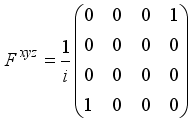 -octopole moment;(24)
 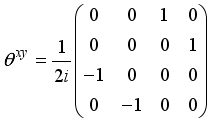 - quadrupole moment. (25)
 (26)
(26) 
| [1] | Kosevich A. M. Kovalev A. S. Introduction to the non-linear physical mechanics. Kiev: Naukova Dumka, 1989, 279 p. |
| [2] | Akhiezer I. A. Bariakhtar V. G. Pletmensky S. V. Spin waves. Moscow. Publishing House “Nauka”, 1967, 368 p. |
| [3] | Molozemov A. Slonzueski J. Domain walls in the materials with cylindrical magnetic domain. Moscow. Publishing House “Mir”, 1982, 348 p. |
| [4] | Abdullaev F. Kh. The dynamics of magnetic solitons under the influence of phonon fluctuations in quasione-dimensional magnetics. FMN, 1984. 57. № 3. pages 450-456. |
| [5] | Fedyanin V. K. Dynamical Formfactor of neutron scattering on solitons in quasione-dimensional magnets. IMM, 1983. 31-34. p. 1237. |
| [6] | Gochev I. G. Quantum domain wall and coherent states for the Heisenberg-Ising spin ½ chain. Preprint JIHR, E 17-84-253, Dubna, 1984; Phys. Lett. A, 1984, v. 104, n. 1, p. 36-37. |
| [7] | Abdulloev Kh. O. Makhankov A. V. Quasiclassical behavior of the initial pack of waves within framework of the Heisenberg lightly-plane model. The Proceedings of the Academy of Sciences of the Republic of Tajikistan. 1991. volume III, № 2, pages 170-174. |
| [8] | de Jongh L. J. Solitons in magnetic chains. J. Appl. Phys. 1982, 53, № 11, pages 8018-8023. |
| [9] | Perelomov A. M. Generalized coherent states and their annexes. Moscow. Publishing House “Nauka”. 1987. 269 p. |
| [10] | Ising E. Neitrag sur theorie des ferromagnetimus. Z. Physik, 1925, v. 31, № 1. 253 p. |
| [11] | Helber P. Experimental investigations of critical Phenomena. – Rep. Prog. Phys. 1967, v. 30 № 2, p. 731-826. |
| [12] | Zumer S. Pseudo – one – dimensional kinetic Ising model. – Phus. Rev. 1980, v. 21 B№ 3, pages 1298 – 1303. |
| [13] | Nakamura E. Abe K. Deduchi K. Quasi-one-dimensional behavior of thermal expansion in ferromagnetic Cs H2 PO4. J. Phys. Soc. Japan. 1984. v. 53, pages 1614-1616. |
| [14] | Malakis A. A polymer model equivalent to the Ising model. – J. Phys. 1980, v. A 13 №, 2, pages 651-658. |
| [15] | Flori P. Statistical mechanics of chain molecules. Moscow. Publishing House “Mir”. 1971. 440 p. |
| [16] | Baxter R. Exactly solvable models in the statistical mechanics. Moscow. Publishing House “Mir”. 1985. 488 p. |
| [17] | Steiner M. Villian J. Windsor C. G. Theoretical and experimental studies on one-dimensional magnetic system. – Adv. Phys. 1976, v. 25, № 2, pages 87 – 209. |
| [18] | Fedyanin V. K. Application of the Grin function and the correlation functions in the study of Ising model. In the book “Statistical physics and quantum theory of field”. Moscow. Publishing House “Nauka”. 1997. pages 241-246. |
| [19] | Zaslavsky O. B. Tsukernik V. M. Relaxation of spin systems in a transversal alternating magnetic field. FNT. 1983. volume 9, № 1, pages 65-73. |
| [20] | Heisenberg W. Zs. f. Phys. 1928. volume 49. p. 619. |
| [21] | Heisenberg W. Metallwirtschaft, 1930, v. 9, p. 843. |
| [22] | Tikadzumi S. Physics of ferromagnetism. Magnetic properties of substances. Moscow. Publishing House “Mir”. 1983. p. 304. |
| [23] | Kosevich A. M. Ivanov B. A. Kovalev A. S. Non-linear waves of magnetization. Dynamic and topologic solitons. Kiev. Publishing House “Naukova Dumka”. 1983. p. 196. |
| [24] | Pushkarov K. Primotorova M. Solitary clusters of spin deviations and lattice deformation in an anharmonic ferromagnetic chain. Phys. Stat. Sol. 1984, v. 123, p. 573-584. |
| [25] | Herring C. Kittel C. On the theory of spin wave in ferromagnetic media. Phys. Rev. 1951, 91, n 5, p. 869-880. |
| [26] | Perelomov A. M. Comm. Math. Phys. 1972, 26, p. 222. |
| [27] | Abdulloev Kh. O. Rahimov F. K. Muminov Kh. Kh. Calculation of quadrupole dynamics of the magnetics with spin S=3/2. The Proceedings of the Academy of Sciences of the Republic of Tajikistan, 1993, № 1, pages 28-30. |
| [28] | Rahimov F. K. Abdulloev Kh. O. Semi-classical description of ferromagnetics with spin S=3/2 in the space SU(2S+1)/SU(2S)*U(1). DAS RT, 1998, v. XLI, № 3-4, pages 45-51. |
| [29] | Remund K. Pohle R. Akagi Y. Romhányi J. Shannon N. Semi-classical simulation of spin-1 magnets. Phys. Rev. Research, 2022, v. 4, № 3, 033106. |
| [30] | Dahlbom D. Miles C. Zhang H. Batista C. D. Barros K. Langevin dynamics of generalized spins as SU(N) coherent states. Phys. Rev. B, 2022, v. 106, № 23, 235154. |
| [31] | Do S.-H. Zhang H. Dahlbom D. A. Williams T. J. Garlea V. O. Hong T. Jang T.-H. Cheong S.-W. Park J.-H. Barros K. Batista C. D. Christianson A. D. Understanding temperature-dependent SU (3) spin dynamics in the S=1 antiferromagnet Ba2FeSi2O7. npj Quantum Materials, 2023, v. 8, № 1. |
| [32] | Zvyagin A. A. Slavin V. V. Zvyagina G. A. Manifestation of spin nematic ordering in the spin-1 chain system. Phys. Rev. B, 2023, v. 107, 134421. |
| [33] | Wei Z. Du Z. Cao X. You W.-L. Lu Y. Quantum criticality and emergent order in the spin-1 bilinear-biquadratic Kitaev chain. Phys. Rev. B, 2025, v. 112 №, 21, 214434. |
APA Style
Rahimi, F. (2026). On the Reduction of Classical Spin in One-dimensional Heisenberg Magnets with Spin S>1/2. World Journal of Applied Physics, 11(1), 7-15. https://doi.org/10.11648/j.wjap.20261101.12
ACS Style
Rahimi, F. On the Reduction of Classical Spin in One-dimensional Heisenberg Magnets with Spin S>1/2. World J. Appl. Phys. 2026, 11(1), 7-15. doi: 10.11648/j.wjap.20261101.12
AMA Style
Rahimi F. On the Reduction of Classical Spin in One-dimensional Heisenberg Magnets with Spin S>1/2. World J Appl Phys. 2026;11(1):7-15. doi: 10.11648/j.wjap.20261101.12
@article{10.11648/j.wjap.20261101.12,
  author = {Farhod Rahimi},
  title = {On the Reduction of Classical Spin in One-dimensional Heisenberg Magnets with Spin S>1/2},
  journal = {World Journal of Applied Physics},
  volume = {11},
  number = {1},
  pages = {7-15},
  doi = {10.11648/j.wjap.20261101.12},
  url = {https://doi.org/10.11648/j.wjap.20261101.12},
  eprint = {https://article.sciencepublishinggroup.com/pdf/10.11648.j.wjap.20261101.12},
  abstract = {This paper develops a semiclassical framework for one-dimensional Heisenberg magnets with spin S>1/2, where classical approaches are reliable only as S→∞ and can miss quantum contributions from multipole moments. The aim is to construct a workable mathematical apparatus that connects the quantum lattice Hamiltonian to an effective classical field description while incorporating an effective reduction of the classical spin length. The analysis starts from an anisotropic Heisenberg chain with nearest-neighbour exchange and single-ion anisotropy. After outlining the continuum (long-wavelength) reduction, including factorization of slowly varying fields and replacement of commutators by Poisson brackets, the semiclassical limit is formulated using a Hartree product ansatz and generalized SU(N) coherent states for each lattice site. For spin S=1 the coherent state is built on the SU(3)/[SU(2)×U(1)] manifold. Two Euler angles define the orientation of the classical spin vector, an additional angle describes rotation of the quadrupole tensor about this vector, and a real parameter g controls the redistribution between dipolar and quadrupolar sectors. Averaging the spin operators yields explicit classical components and shows that the standard constraint |S|^2=1 is violated. Instead, an identity relates the reduced spin length to a combination of double correlators, demonstrating that quadrupolar degrees of freedom quantitatively produce a measurable renormalization of the effective classical spin. For spin S=3/2 the construction is generalized to SU(4) coherent states, where both quadrupole and octupole moments arise naturally. The averaged spin operators again violate spin-length conservation and, moreover, simple projection sum rules. The corresponding SU(4) identities involve combinations of triple correlators and introduce parameters g and k that quantify reductions due to quadrupolar and octupolar sectors, respectively; the SU(3) case is recovered when k=0. The framework provides a transparent route to include multipolar physics in semiclassical dynamics and is relevant for interpreting nonlinear collective excitations, including soliton-like modes, in quantum spin chains.},
 year = {2026}
}
TY  - JOUR
T1  - On the Reduction of Classical Spin in One-dimensional Heisenberg Magnets with Spin S>1/2
AU  - Farhod Rahimi
Y1  - 2026/02/27
PY  - 2026
N1  - https://doi.org/10.11648/j.wjap.20261101.12
DO  - 10.11648/j.wjap.20261101.12
T2  - World Journal of Applied Physics
JF  - World Journal of Applied Physics
JO  - World Journal of Applied Physics
SP  - 7
EP  - 15
PB  - Science Publishing Group
SN  - 2637-6008
UR  - https://doi.org/10.11648/j.wjap.20261101.12
AB  - This paper develops a semiclassical framework for one-dimensional Heisenberg magnets with spin S>1/2, where classical approaches are reliable only as S→∞ and can miss quantum contributions from multipole moments. The aim is to construct a workable mathematical apparatus that connects the quantum lattice Hamiltonian to an effective classical field description while incorporating an effective reduction of the classical spin length. The analysis starts from an anisotropic Heisenberg chain with nearest-neighbour exchange and single-ion anisotropy. After outlining the continuum (long-wavelength) reduction, including factorization of slowly varying fields and replacement of commutators by Poisson brackets, the semiclassical limit is formulated using a Hartree product ansatz and generalized SU(N) coherent states for each lattice site. For spin S=1 the coherent state is built on the SU(3)/[SU(2)×U(1)] manifold. Two Euler angles define the orientation of the classical spin vector, an additional angle describes rotation of the quadrupole tensor about this vector, and a real parameter g controls the redistribution between dipolar and quadrupolar sectors. Averaging the spin operators yields explicit classical components and shows that the standard constraint |S|^2=1 is violated. Instead, an identity relates the reduced spin length to a combination of double correlators, demonstrating that quadrupolar degrees of freedom quantitatively produce a measurable renormalization of the effective classical spin. For spin S=3/2 the construction is generalized to SU(4) coherent states, where both quadrupole and octupole moments arise naturally. The averaged spin operators again violate spin-length conservation and, moreover, simple projection sum rules. The corresponding SU(4) identities involve combinations of triple correlators and introduce parameters g and k that quantify reductions due to quadrupolar and octupolar sectors, respectively; the SU(3) case is recovered when k=0. The framework provides a transparent route to include multipolar physics in semiclassical dynamics and is relevant for interpreting nonlinear collective excitations, including soliton-like modes, in quantum spin chains.
VL  - 11
IS  - 1
ER  -
National Academy of Sciences of Tajikistan, Dushanbe, Tajikistan




 Share This Article
 Twitter
 Linked In
 Facebook
 Copy
Copy Download